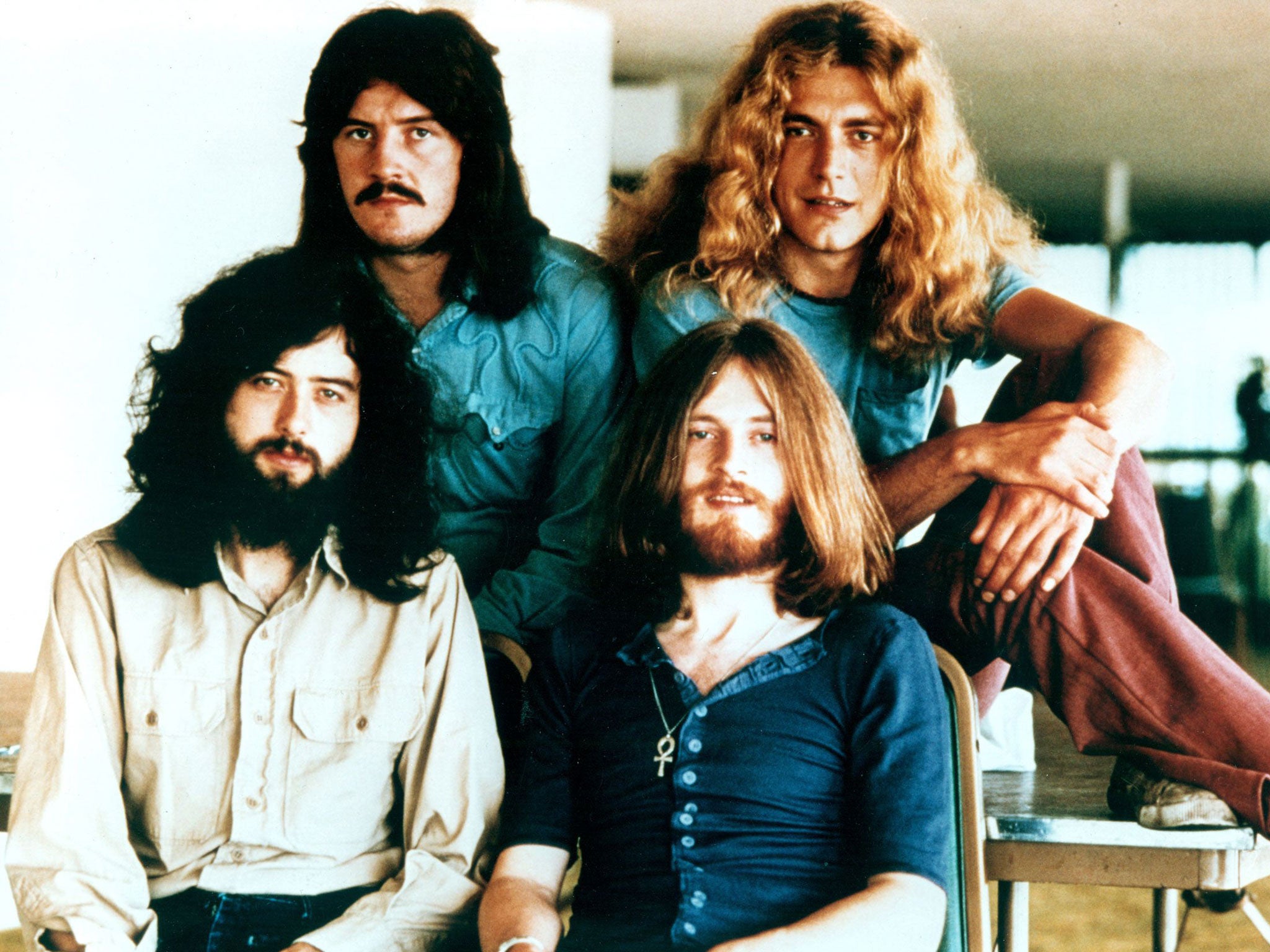
Yeah, it's a Led Zeppelin two-fer. However, whereas yesterday's song gets overlooked, Kashmir is an undisputed classic. Even the band members felt that this song best expressed their vision.
It opens with a crash of cymbal with a waltzing 3/4 string/guitar progression accompanied by a 4/4 drum pattern. It's what makes the song so interesting, this confluence of different time streams. Keeps things slightly tipsy. Personally, I cannot hear the opening of Kashmir without also being aware of the ending of Trampled Underfoot, the song that precedes it on the album. It is a fleeting moment, but it's there in my brain.
My favorite part of the song is the minimalist section that lasts from 2:18-3:14; there is so much breathing room in it, Bonham's drums combined with the bass and the descending string slides. Very seductive.
Kashmir is a perfectly realized masterpiece by the band, with a circular theme that rotates around its axis with precision, sections linking up with each other like clockwork. Nice flanging and phasing here and there, mostly on the drum flurries; e.g., 7:50.
Most fans probably know the scene in Fast Times at Ridgemont High when Ratner is instructed by Damone to play side one of Led Zeppelin IV, but he 'messes up' by playing Physical Graffiti instead. Not true, says I. Any Zeppelin album would make a good choice. Well, maybe not side two of In Through the Out Door. So much has been written about this song, you can find many online treatises that analyze its brilliance. I prefer to let it all wash over me like an oasis in the desert.
This song doesn't get enough respect. How Many More Times is the engine that drives the Led Zeppelin I bus, and it does so with an emotionally bold and lascivious hormonal spirit. Meanwhile, the passengers travel in relative comfort. Popular Good Times Bad Times sings along with the kids up front and the mysterious Dazed and Confused dazzles everyone in the center, spinning tales of its latest 30 minute live adventure. "Yeah, you're exactly right, girls, when Jimmy gets out the bow I do sound pretty amazing, don't I?" Hyperactive Communication Breakdown blathers away to itself and makes faces out the window. Only sadly romantic Babe I'm Gonna Leave You up near the front and quietly smoldering You're Time Is Gonna Come are aware of the dark power that pushes them along.
How Many More Times is Dazed and Confused's less colorful sibling. It's a heavy blues rock epic with a Bradbury Something Wicked This Way Comes shell around it. Eerie and sinister, you can tell that there's some strange magic coursing through its veins. It starts off all cool and cocky, swinging cymbals and walking bass, stepping down into a smoky club. Then Jimmy Page paints on some late 60s wah chords and shakes us by the scruff of our necks. At 0:35 we step on the gas, as John Bonham pounds the skins and Robert Plant moans out
How many more times, treat me the way you wanna do...
It is a muscle car of a riff, open E-octave higher E-D-B-D, repeat. The distorted guitar and bass play in unison, creating a thick tone that can also be heard in the main riff of Black Dog. Robert sings a bunch of grumbling jealous guy blues.
At 2:03, we head into a tunnel, torches burning along the walls. Page cranks out the heavy psych riffs and Bonham plays one amazing fill after another. At 3:03 we appear to take on a drum corps and some heavy military equipment that we might need as we approach a hazy and unexplored territory.
We enter this kind of murky Area 51 at the 3:40 mark. Kind of a slowed down cross between the middle sections of Whole Lotta Love and Dazed and Confused. Jimmy bows the guitar and Bonham lightly dances upon the drums. Robert himself is in a fog, surrounded by the ghosts of old bluesmen:
I was a young man, I couldn't resist...
By 5:10 we are accelerating towards the light at the end of the tunnel. However, before we exit, at 5:30 we are stopped by Rosie at the tollbooth. We chat with her for a bit, pleading with her to come along with us. At 5:48 the drum corps start to get anxious. "We need to be at the base by 2200 hours, driver. Little Robert Anthony can play later. Let's get going." Well, this doesn't sit well with the band. Jimmy plays some spiky chords and whips some notes at the drum corps. Robert warns the drum corps to relax:
Well, they call me the hunter, that's my name..."so you guys just calm down, OK? Don't make me mad." Robert waxes nostalgic about his hunter exploits, then finally at 7:06 the driver has had enough and the bus heads off down the road and into the night.
This version of Hear My Train A Comin' is from the album The Jimi Hendrix Concerts. It was recorded at Winterland, in San Francisco, on October 10, 1968. It is my favorite live recording of his, since the first time I heard it. Unfortunately, this particular version is not available on youtube, due to copyright issues, so I made my own video for it using Windows Movie Maker. I posted it on youtube, but the it was removed. I hope it doesn't get pulled here and I don't get banned from blogger.
It feels somewhat similar to Voodoo Chile, but without Steve Winwood's organ. As Jimi says prior to beginning the song, 'it's nothin but a jam.' His opening guitar riff sets the table, and I love it when Noel Redding and Mitch Mitchell come in at around 0:35. The bass has this great full bottom tone and it really locks into a groove from which Jimi takes off on the guitar. It's a slow blues that hits its stride around the three minute mark, when Jimi begins his solo. I especially love the solo from the 3:55 point on, and those pitch bends from 4:21-4:30 are something else. From there he just goes into the stratosphere. Genius. After 5:30 he does that thing where he plays the same notes on the guitar that he's singing. Come back and buy this town...and put it all in my shoe. He ends it all with a snippet of First Call...and the horses are on the track.
Dying butterfly began to fly!Butterfly is like listening to a lunatic's intense play-by-play of a butterfly struggling to live as it flutters about in a garden. (I think I've seen this guy on the MAX a few times.) He goes on about a few other personal matters, but I'm too bewildered to pay much attention. I mean, is the butterfly going to be OK?! That's what most concerns me. That and hoping he doesn't ask me about the butterfly. I have no idea. But the song is over eight minutes so maybe I will figure it out.
Malcolm Mooney is one intense vocalist. I can't blame him, listen to the music! The drums and guitar assault your ears like the king's blacksmith pounding out a sword of vengeance. The guitar chords are huge metallic chunks flying dangerously in all directions.
At some point Malcolm says the dying butterfly never dies. For chrissakes, put it out of it's misery, you sadist!
Safesurfer is my favorite song by one of the most important musical figures in my life, Julian Cope. It is a sprawling eight minute guitarfest, a song about AIDS and the chilling consequences of not practicing safe sex just because a partner says they're clean:
You don't have to be afraid love
Cause I'm a safesurfer darlin
The music begins and ends with guitars. It starts off with a low strummed acoustic being overrun by a heavy electric threatening feedback. Another guitar enters the fray at 0:14. and the two guitars snake around each other as cymbals crash about. At 0:51 the drums lock into a groove that propels us forward through the haze of guitar pyrotechnics. Organ and piano join up at some point as well.
At 2:52, Julian finally decides to speak up:
And I saw my old man
Exploding out of the tunnel...
At 3:19, the guitars disappear and we are at the bottom of a slow climb back to them through piano and organ. Julian repeats the lover/murderer safesurfer mantra over the next few minutes, adding voices to show how so many people have this kind of twisted belief in personal invulnerability. As Julian himself writes in the liner notes in Peggy Suicide, 'Safesurfer is that guy we all know; you overhear him with some girl saying "I'm not like the others, darling. Don't you trust me?" like HIV ain't never coming down.'
The guitars shoot back into the song at 5:19, exactly two minutes after they disappeared. They attempt to drown out the vocals. Piano chords rise and fall, everything is a big ball of sound.
When I first heard Safesurfer, there was a particular moment that just blew my socks off, and still does. It happens at 6:10 - everything is bubbling away when this amazing distorted guitar riff completely splits the atmosphere. From here to the end we are subjected to phasing, heavy synth chops, some sort of stringed cello or something, everything dissolving and reanimating, spiraling out into space.
Sometimes I can't get over how beautiful Stairway to Heaven is. There's a reason it is often number one on lists of the greatest rock songs of all-time. The way it gracefully builds from quiet reflection to transcendent glory, journeying through mystic landscapes, adding layers of sonic majesty; it is a dazzling experience.
It opens with a medieval caravan traveling among moss-covered
stones in a misty ancient forest: the smell of earth and
leaves, fungi, ferns, faires, friars, fairies, fires, elves and wizards,
dungeons and dragons. Troubadours accompany the group, playing delicate notes on guitar and recorders. Sunlight breaks through the trees here and there, a scene of peace and serenity.
At 0:53, Robert Plant sings the first words:
There's a lady who's sure All that glitters is gold And she's buying a stairway to heaven.
Who is this lady? She is part of a royal court, perhaps a queen, and she is in one of the wagons, accompanied by her servants, traveling in great comfort, but she is also dying and she feels alone. She drifts in and out of a dream state, her reality merging with visions of the afterlife. She imagines that with all her wealth she should simply be able to buy her way into heaven, but she's not sure. The timbre of Plant's voice is like a quiet stream of cool water.
At 1:47 the lady's subconscious creates realms of existential trials and visions:
In a tree by the brook There's a songbird who sings Sometimes all of our thoughts are misgiven.
She hallucinates smoke rings and ghostly voices, pipers and bustles in hedgerows, laughter ('does anybody remember laughter?' I wonder if anyone in the audience felt obligated to laugh when Robert said this. 'I do, Robert! Hahaha!') and May-queens, as natural reality blends with her soul's departure into the afterlife.
The music changes with her. At 2:15, acoustic and electric guitars strum together, joined by electric piano, weaving a tapestry of wonder and mystery at 2:40 as Robert sings, There's a feeling I get When I look to the west.....
The song achieves magical proportions at 4:19 when John Bonham's mighty drums suddenly burst into the mix. The timing is perfect, and it shifts the song into a higher gear, propelling the lady's journey further away from the mortal coil. Bonham's drums sound so full and crisp, the reverb is exactly spot on, and he hits the skins with a power that just bursts through the speakers.
From here on out the music soars. At 5:08 Robert sings Your head is humming and it won't go. The lady is dying, her soul is about to leave her body and fly to heaven on the whispering wind.
At 5:33 there is a crashing of time and space followed by walls of electric guitars; the lady has died and her soul is entering heaven with great pomp and circumstance. Jimmy begins his otherworldly solo at 5:57, coloring the scene with golden notes that ring out across the world like bells.
Robert brings out his metal god voice for the final passage. The shining spirit of the lady appears to her people, desiring to show that everything turns to gold in the end, entering heaven has nothing to do with money, it's all about being faithful, staying true to your beliefs. I think this is what the line to be a rock and not to roll means. The rock of faith, don't roll from it, and you will turn to gold in the end. I may be stretching it a bit, but Robert has said 'this is a song of hope'. I hope so.
Consider the opening 0:51 of War Pigs. It explodes like a bomb hitting the ground in one of those WWII aerial films - simultaneous heavy guitar, bass and cymbal crash. While the chord sustains, a few more bombs are seen falling beneath us, through a grey sky towards a black and white city below. Listen to the guitar at 0:07, this kind of hammered-on note an octave above the root. It is like the sudden moment of impact, with the waves of destruction rippling outward. Away to the west, tanks crawl slowly across farm fields, prepared to blow away anything in their way. At 0:31 a warning siren in a nearby town calls for everyone to evacuate.
At 0:52 the pace quickens with sharp stabbing chords and pulse-quickening hi-hat. Ozzy Osbourne begins to sing at 1:03:
Generals gathered in their masses Just like witches at black masses (or my preference, 'smell each other's stinky asses')
I like the double meaning of 'mass'. Similar to 'please please me' by The Beatles. The rest of Geezer Butler's lyrics are good, and it's a great anti-war song but (hey, but butt me whoa yeah, like I butt you, haha), you know what? I've never liked Ozzy's voice all that much. That's all I'm going to say about it.
Tony Iommi plays fantastic guitar throughout: those triplets at 1:29, the trill at 1:34, the descending chords at 1:48, the little bend at 1:50, the chug and slash part from 2:08-2:17 and the riffs that accompany Politicians hide themselves away. Beginning at 3:30 he plays several solos that overlap until around 4:20. I love those pitch bends from 4:13-4:18. A very clever guitarist.
Bill Ward plays excellent drum fills everywhere, particularly at 1:38, 1:52, 1:57, 2:02 and on and on, through Iommi's solo, and 5:28-5:30. Geezer Butler holds it all down with his mighty bass playing.
The final 2:12 is a section called 'Luke's Wall'. It's a pretty cool way to end the song. Some great drums in this part, too. And bonus: no Ozzy.
LA Woman is the quintessential Doors song, and one of Jim Morrison's most inspired vocal performances. It is an ode to Los Angeles, their home, a place of beauty and decadence, a lyrical postcard of an endless night in the sprawling urban wilderness. It begins with the sound of an engine revving off down the highway, then cymbals and a quickly picked bass line. John Densmore's snare beats into Ray Manzarek's descending Rhodes keyboard on the left, complemented by Robby Krieger's guitar on the right. They do their own little licks, then at 0:45 a rhythm guitar arrives on the scene. We're in a big rumbling vehicle and we're heading into the city. Jim Morrison is at the wheel:
Well, I just got into town about an hour ago...I always heard 'Well I dig a little diner bout an hour ago.' Morrison doesn't really enunciate, his voice flows like warm beer on a hazy west coast morning. Robby Krieger mimics his voice with guitar licks, like a dialogue between driver and vehicle. Jerry Scheff, a familiar name to Elvis fans, plays bass on the tune and he has some cool moments during the city of night part (1:23). Morrison whoops at 1:30, he's got energy to burn, and Robby picks a cool rising lick off of it.
At 2:40, following the Sunday afternoon drive through your suburbs section, Manzarek, who by now has switched to tack piano, plays a lively barroom solo. At 3:02, things momentarily calm down into I see your hair is burnin', hills are filled with fire. The instruments dance a little samba, then Morrison steps on the gas at 3:36 - Drivin down your freeways.
At 4:18, let's change the mood from glad to sadness. Whatever you say, Jim. Manzarek is back on the Rhodes, Krieger plays some blues guitar. Yup, sadness. Finally, at 4:55, Jim starts in with Mr. Mojo Risin', an anagram of Jim Morrison. He gets into it, and the band picks up the pace. In high school biology class, my friend Fred used to sing 'Mr Mojo Rhizopus' (we were studying plants).
Around the 6:00 mark or so, the mood has changed back to gladness. Jim is whoopin it up, the band is cruising along. Jim makes a weird little noise at 6:09, some sort of grunt. We are back to the first verse, continuing down the highway, perhaps to San Diego or Tijuana.
Riketzo Makuyu "Rikki" Ililonga - Lead Guitar, Vocals
Ndara "Derreck" Mbao: Bass Guitar, Lead Vocal
Aliki Kunda: Western Drums, Vocals
Siliya Lungu: African Drums, Vocals
Kenny Chernoff: Soprano Saxophone
John Bobby Otieno: Rhythm Guitar
Brother Njenga: Trumpet
Zambia...what a cool name. And Lusaka, its capital. Musi-O-Tunya is a variation on Mosi-O-Tunya, which means "thundering smoke" and is the Zambian name for Victoria Falls. The Brits occupied the area from around 1888 until 1964, when Zambia gained independence.
So, as young musicians in the 60s and 70s, these Zambian rockers experienced the joy of rock n roll and the pride of independence. You can hear it in the music, the fun and the excitement of rocking out in their own country. Western music without Western rule.
Walk and Fight starts off with some cymbals, double pounding drums and congas. At 0:21, the horns and guitars arrive, making a proclamation of sorts. It reminds me somewhat of Sonny Sharrock's Ask the Ages album, that unison of sax and distorted guitar. The lyrics come in at 0:56:
Man, man, who lived in the jungle, for so many years...
At 2:06 it switches into a new section of falling and rising horn riffs and electro-sputtering wah wah guitar. I love the dual rising rhythm and wah guitar moments, like around 2:10, 2:18, etc. It's a sweet little riff. We dip back into a repeat of the first section at 2:36.
Into the second section again at 4:10, and this time around Rikki Ililonga plays some wicked licks on the guitar from 4:24-4:48. Ndara Mbao's bass also stands out more during this section, dropping in some cool licks around Rikki's guitar. The horns keep kicking out the jams all through it.
At 5:08 we enter a final section, one of victory and liberation. The man has risen up and freed his people, walking and fighting with his guns and arrows. One more trip through the first two sections as the freedom children dance off into the sunset.
It begins with some distorted bass, then some voices, the most audible being a woman who talks about how she was depressed and so she started reading Revelations from the Bible. At 0:30, Curtis comes on like a preacher: Sisters! Niggers! Whiteys! Jews! Crackers!...then he screams, and his voice fades into madness.
The music swirls into a groove at 1:08, with drums, strings, horns, and wah guitar. It is classic socially aware early 70s soul, along the lines of Isaac Hayes and the Temptations. The music rolls along as Curtis raps about how society is really messed up and no one is doing anything about it because it's all just politics, no one in power really has an interest in improving things. Nixon talking about don't worry...like the problems will somehow just go away.
But they don't know There can be no show And if there's a hell below We're all gonna go, go, go, go, go
I love Curtis Mayfield, what a unique and powerful voice. He sounds so calm and soothing while singing warning messages. Kind of like the Lorax...ok, people, you can sit there and let the bad stuff happen, but it's not going to get any better unless you get on your feet and use your collective power to help change things. Forty-six years later...incredibly, this kind of song is more relevant than ever.